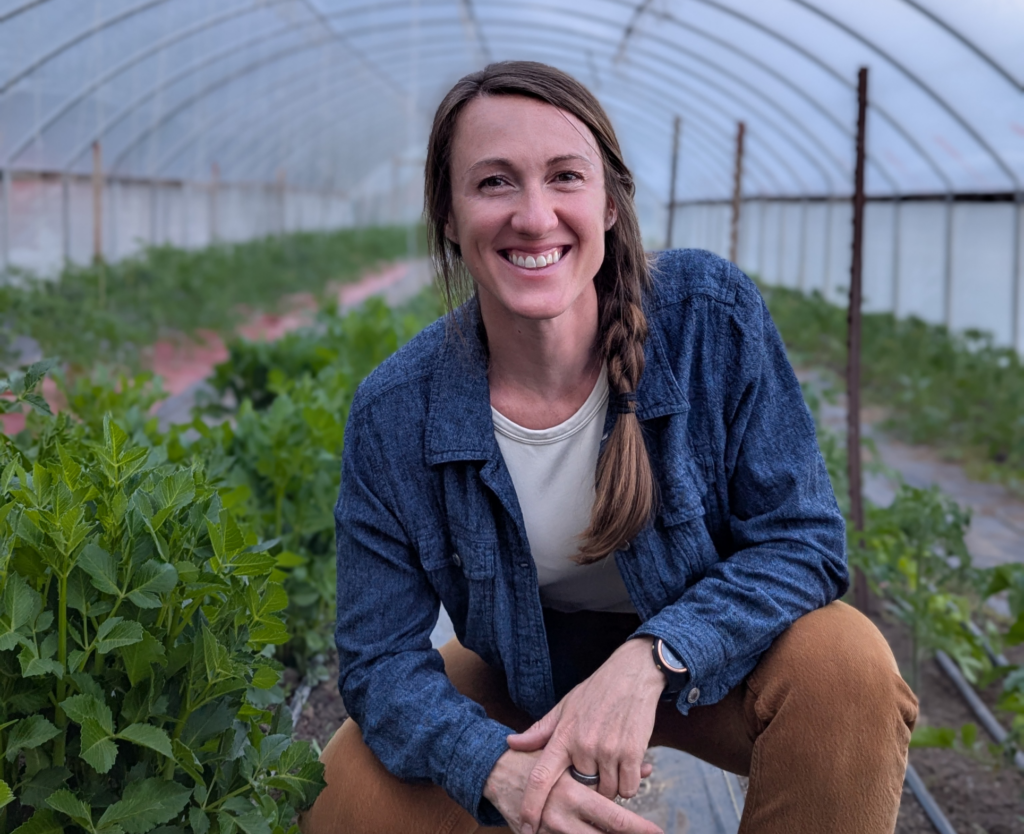
Michele Schahczenski is the Organic Outreach Coordinator for the Transition to Organic Partnership Program (TOPP) in the Department of Plants, Soils and Climate at Utah State University. The university participates in this program as part of the West/Southwest TOPP region, which is overseen by the CCOF Foundation.
TOPP is a nationwide USDA initiative to provide mentorship, technical assistance, and wrap-around support to transitioning and existing organic producers. Through TOPP, the CCOF Foundation leads the Western & Southwestern Regional Center for Organic Transition, working with a coalition of partners to support producers in Arizona, California, Hawaii, Nevada, New Mexico, Utah, and Texas. In her role, Schahczenski supports current and transitioning organic farmers and ranchers through mentorship, technical assistance, and community building.
When she first started working as part of TOPP in 2024, a year after the program began, Schahczenski recognized an ambitious framework aimed at supporting the goal of helping Utah farmers transition their land to organic. Charged with getting the program up and running quickly, Schahczenski’s priority was to get the word out to more farmers and get more farmers involved in the mentorship program so they could jump into action.
“The organic industry in Utah is quite small,” Schahczenski says. “For example, there are only seven or so certified organic vegetable producers in Utah, so as we were getting started, we were limited in who we could work with.” She recalls the annual conference hosted by Red Acre Center, a Utah farming nonprofit, where she used to hear people talking about organic agriculture in hushed terms. “Organic was, like, a dirty word,” she says. “We talked about sustainable, small-scale food systems, but we didn’t really use the word ‘organic.’”
After TOPP began to reach more farmers, public sentiment around the word began to change. “It’s been awesome,” Schahczenski says. “People are talking about organic now. This year and last, the conference had a few keynote speakers who were certified organic.”
“It’s great to see how much interest in organic has improved, exponentially, each year,” she says. “We’ve had growing interest in the mentorship program, too. Like, in the first year, we were wondering if we could even find three farmers, and now we’ve had 18 mentorship matches. We’ve seen a farmer add more organic acres. People started from not even considering the word ‘organic,’ and now they’re working through the process. It takes time for the acres to transition, but I feel confident that this program has made people understand what certified organic is, and the organic acreage in Utah will continue to grow.”
As part of her role, Schahczenski finds herself frequently on the phone with farmers, providing technical assistance and holding workshops. “What I see most is the broader community that’s grown around organic,” she says. “Like this January, we brought all of our mentors and mentees down to the Red Acre Center conference and had a meeting and lunch afterwards. There were producers from the northern and southern parts of the state who had never met before. But they were talking, farmer to farmer, about how they were trying similar things and having similar struggles, all working toward getting certified and understanding the practices together. Now they know who they can turn to and who’s resolving which issues in which ways. Seeing that community being built has been so impactful.”
Schahczenski says the shift toward organic has been especially impactful in Utah. “We’re talking about resilience,” she says. “People want to protect their environment for the longer term, and that means using organic practices that feed into soil and water conservation. Because it’s a very low-water area, we need to focus on not polluting waterways, and building soil health so we can use the water we do get.”
She also sees organic practices becoming more impactful for expanding producer sales. “Here in Utah especially, we’re seeing a big increase in population, with a lot of people coming from out of state,” Schahczenski says. “A lot of Utah farmers say, well, certification doesn’t matter because I’ll just tell people that I’m using basically organic practices. But as more people come into the state, there are more customers who don’t personally know you or your practices, and certification can help those farmers market to a larger audience.”
Schahczenski notes that this applies especially to Utah’s many community-oriented growers, who are using organic practices but have never gone through certification. In order to make the jump from CSA boxes to grocery stores or food hubs, they need to be able to prove to customers that their organic practices aren’t just talk. “Even at the Salt Lake Farmers Market,” she says, “there are tons of growers and you want to distinguish yourself. If you’re the only one who actually has the Certified Organic sign to prove you actually do use organic practices, you stand out. Having something that can communicate your values to customers is huge.”
Although TOPP is ending in 2026, Schahczenski hopes that similar programs will continue to expand TOPP’s impact. “The program has provided so much needed support for organic as an industry,” she says. “What sticks out about TOPP is the farmer-to-farmer sharing. It’s not just that farmers are talking to each other, but that they’re able to get paid for sharing their expertise. Farmers’ time is extremely valuable. If they’re hosting field days and giving technical advice, being able to pay them for their time and make sure that their expertise is compensated is extremely deserved.”
Schahczenski sees the need for federal investment in the organic sector, especially in areas without the infrastructure that some states built over decades. “There’s this idea that organic will just grow, but we need to invest in it properly,” she says. “The TOPP program not only connected farmers for mentorship, but also created so many new positions for people like myself in the extension world. Usually, extensions don’t have an organic emphasis; until last year, I was the only person here [at USU] whose job is focused on organic. There’s research, mentorship, technical assistance, and so much happening. You can’t just say that you wish organic would grow. You need to fund all those arms if you want to get it to actually grow. We definitely need more programs like this.”
-
Los envases de la Programa de asociación para la transición a la agricultura orgánica (TOPP) es una iniciativa a nivel nacional que brinda apoyo a los productores orgánicos en transición y a los ya establecidos en seis regiones geográficas de los Estados Unidos (incluida la región del Oeste/Suroeste, que coordina la CCOF).
-
¿Quieres apoyar a la próxima generación de productores orgánicos? Haz una donación a la Fundación CCOF. Nuestras subvenciones para la transición a la agricultura orgánica ofrecen financiamiento, asistencia técnica personalizada en materia de agricultura orgánica, acceso a programas de mentoría y oportunidades de capacitación empresarial a los agricultores que están pasando a la agricultura orgánica durante un período de tres años.